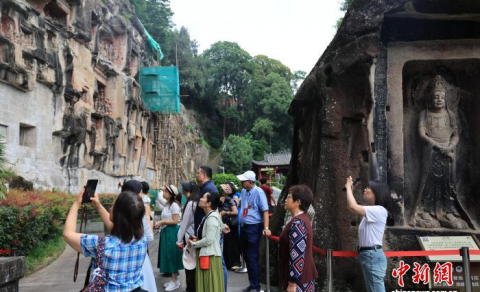
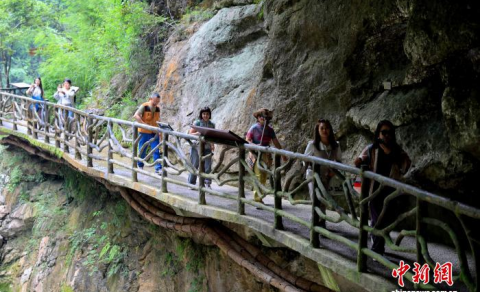
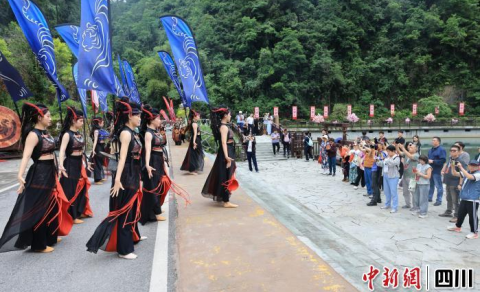
Sichuan News Service, June 12 — Clouds drifted among the mountain ridges, while wooden walkways wound their way through the forests. On June 11, representatives of overseas Chinese-language media participating in the “2026 Overseas Chinese Media Sichuan–Chongqing Tour—Focusing on the Development of the Chengdu–Chongqing Economic Circle” visited the Bashan Grand Canyon in Xuanhan County, Dazhou City, Sichuan Province. Amid towering peaks, deep gorges, and rich local traditions, they experienced the unique appeal of cultural tourism where nature and humanity converge in the heart of the Daba Mountains.
Located at the junction of Sichuan, Chongqing, and Shaanxi, the Bashan Grand Canyon is an important birthplace of Ba culture and the only major Tujia ethnic settlement area in Sichuan Province. Situated within China's north-south climatic transition zone, the region boasts a forest coverage rate of over 80 percent. Its mountains, canyons, streams, waterfalls, and caves form a diverse natural landscape, earning it titles such as the “Hometown of Ba Culture in China,” the “Natural Fold Museum,” and the “Biodiversity Gene Bank of the Daba Mountains.”
Standing at a mountain viewpoint overlooking the scenery, Liu Liping, deputy editor-in-chief of Fiji Daily, admired the layered mountain ranges and winding valleys disappearing into the mist. “My most immediate impression is the deep canyons, steep peaks, and dense forests,” she said.
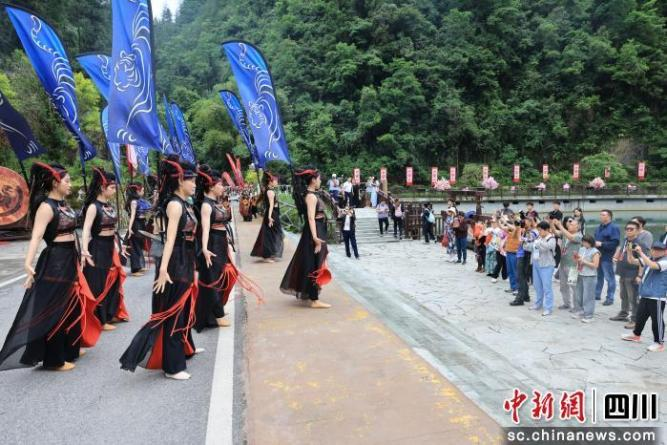
On June 11, representatives of overseas Chinese-language media participating in the “2026 Overseas Chinese Media Sichuan–Chongqing Tour—Focusing on the Development of the Chengdu–Chongqing Economic Circle” visited the Bashan Grand Canyon in Xuanhan County, Dazhou City, Sichuan Province. Photo by reporter Zhang Lang.
Wu Mingshan, a guide at the Bashan Grand Canyon Scenic Area, explained that the destination features natural attractions such as Fairy Rock, Elephant Cave, Guanmen Stone, and Pearl Curtain Waterfall, while also preserving Tujia folk customs and legends of Ba culture.
“Culture is the most distinctive characteristic of the Bashan Grand Canyon,” Wu said. Centered on the theme of “The Homeland of Ba Descendants and the Source of Tujia Culture,” the scenic area has developed attractions including the Bashan Light Cultural Museum, the “Flying Over the Grand Canyon” VR Experience Hall, and the multi-dimensional Elephant Cave Experience Space, transforming Ba culture from static displays into immersive experiences.
Sports activities have further unlocked the potential of the region’s mountainous resources. According to Wu, events such as the Bashan Grand Canyon Cycling Hill Climb Masters Race—held along what is known as “China’s Most Beautiful Rural Road”—as well as square dancing competitions and other cultural and sporting activities, have been organized in recent years.
Looking ahead, the scenic area plans to leverage its mountain canyons, forest trails, and boardwalks to introduce more outdoor experiences, including hiking, cycling, mountaineering, and camping.
“The destination offers not only spectacular natural scenery and rich cultural heritage, but also the kinds of sports and recreational experiences that appeal to younger visitors,” Liu said. “It successfully connects landscapes, culture, sports, and consumer experiences, creating a well-rounded travel experience.”
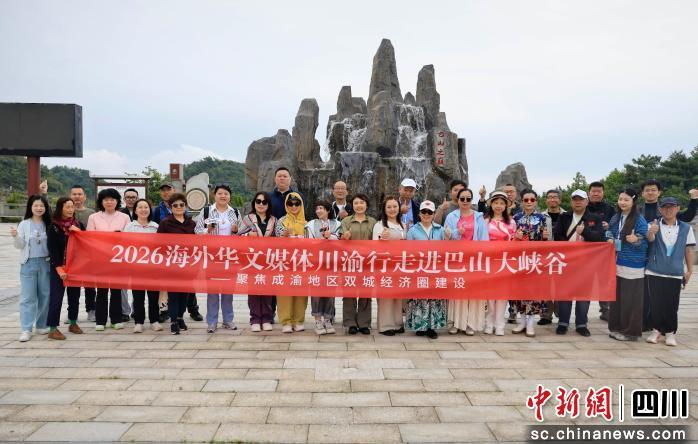
Representatives of overseas Chinese-language media participating in the “2026 Overseas Chinese Media Sichuan–Chongqing Tour—Focusing on the Development of the Chengdu–Chongqing Economic Circle” visit the Bashan Grand Canyon in Xuanhan County, Dazhou City, Sichuan Province, on June 11. Photo by Zhang Lang.
“To better integrate into the Chengdu–Chongqing Economic Circle, the Bashan Grand Canyon Scenic Area has continuously worked to improve transportation access,” said Yang Lei, head of the Publicity and Culture Section of the Dazhou Culture and Tourism Integration Development Center. With major infrastructure projects such as the Xi’an–Chongqing High-Speed Railway progressing, accessibility from key visitor markets including Chengdu, Chongqing, and Xi’an is expected to improve significantly.
Yang added that the Bashan Grand Canyon is currently accelerating its bid to become a National 5A Tourist Attraction, China’s highest rating for scenic destinations. The site has already passed the Ministry of Culture and Tourism’s landscape resource evaluation for 5A-level attractions and is now focusing on enhancing resource protection, service quality, tourism products, smart tourism systems, and brand promotion.
“For the Bashan Grand Canyon, pursuing 5A status is not merely about obtaining a rating,” Yang said. “It is also about upgrading the overall visitor experience, operational management, and service capabilities to ensure every traveler enjoys a higher-quality journey.”